
Clark County Sex Offender Checks
The official starting point is the Illinois State Police registry disclaimer. After accepting its terms, a reader reaches the public search maintained by ISP. The registry is updated daily, so it is the best broad source for a current Clark County sex offender lookup. A court file answers a different question. It can show the conviction and orders in a Clark County prosecution, while the registry shows the public registration status and location data that state law permits ISP to display.
Start with the few facts known with confidence. A name search can find a person, while a county, city, ZIP, or map search works better for community awareness. Similar names and changed addresses make identity checks important. Compare the photograph, birth date, physical details, aliases, registering agency, offense information, and status before drawing a conclusion. For broader county criminal record context, the Clark County criminal history overview explains how court, police, jail, and state records differ.
The public registry does not contain every police narrative or court paper. For a conviction file, use the Clark County Circuit Clerk. For an incident report, ask the investigating agency. For a current registration duty or suspected violation, contact the police agency that registers the address.
Clark Registry Status and Updates
ISP says the public registry updates each day. That schedule makes the status field useful, but the label still needs care. A status reflects the registration system at that point in time. It does not announce a new conviction, prove that a person is at a place at each moment, or replace a call to law enforcement when safety is at risk.
The official Illinois registry search interface illustrates the filters and result layout used for Clark County searches.
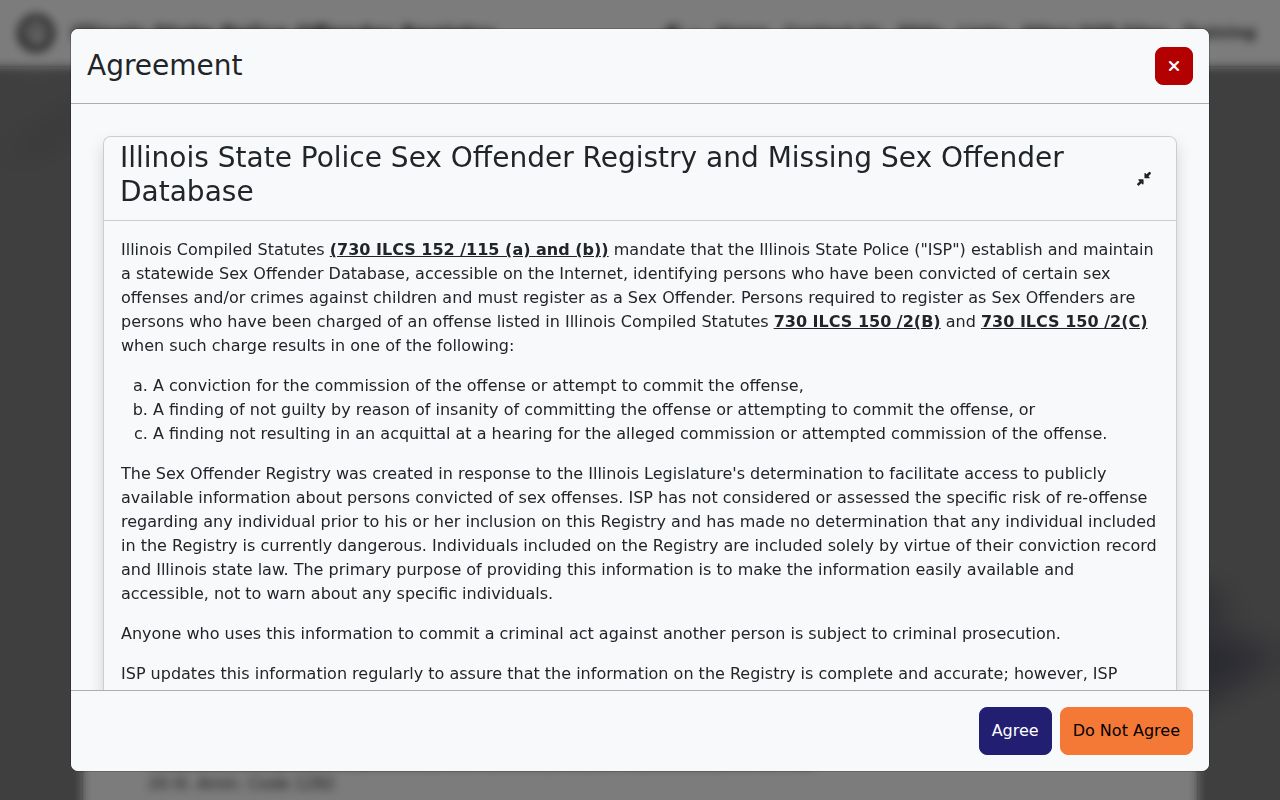
The screen is a search tool, not a substitute for confirming a profile with ISP or the local registering police agency.
Illinois Sex Offender Registry Searches
The Illinois Sex Offender Registry public portal supports both person-based and place-based searching. No single field is required in every search mode. Broad searches can produce many matches, so narrow only with facts that are known. An incorrect birth date or spelling may hide the right result.
- Open the ISP disclaimer, read the permitted-use notice, and accept it to reach the public registry.
- Enter a first and last name, or begin with Clark County, a city, a ZIP code, or Map Your Neighborhood.
- Narrow results with date of birth, status, homelessness, or offender type when those facts are known.
- Open the profile and compare identity, address, offense, registering agency, duration, and compliance fields.
| Field Label | Type | Required | Notes |
|---|---|---|---|
| First and Last Name | Text | No | ISP suggests starting with both names. |
| Date of Birth | Date or text | No | Use an exact date only when known. |
| City or ZIP Code | Text | No | Narrows a place-based search. |
| County or Custody Area | Dropdown | No | Includes Clark, incarcerated, and out-of-state choices. |
| Status, Homeless, Type | Filters | No | Refines compliance and statutory categories. |
| Map Your Neighborhood | Map or address | No | Opens details from yellow map markers. |
Map Clark County Registry Addresses
Map Your Neighborhood lets a reader begin with a Clark County address or a point selected on the map. Yellow markers lead to profile details. This is useful when the reader does not know a person's name. The map should be read as a public notification layer, not as a measure of risk for a whole street or town.
The ISP public registry portal shows how its map and public search work together.
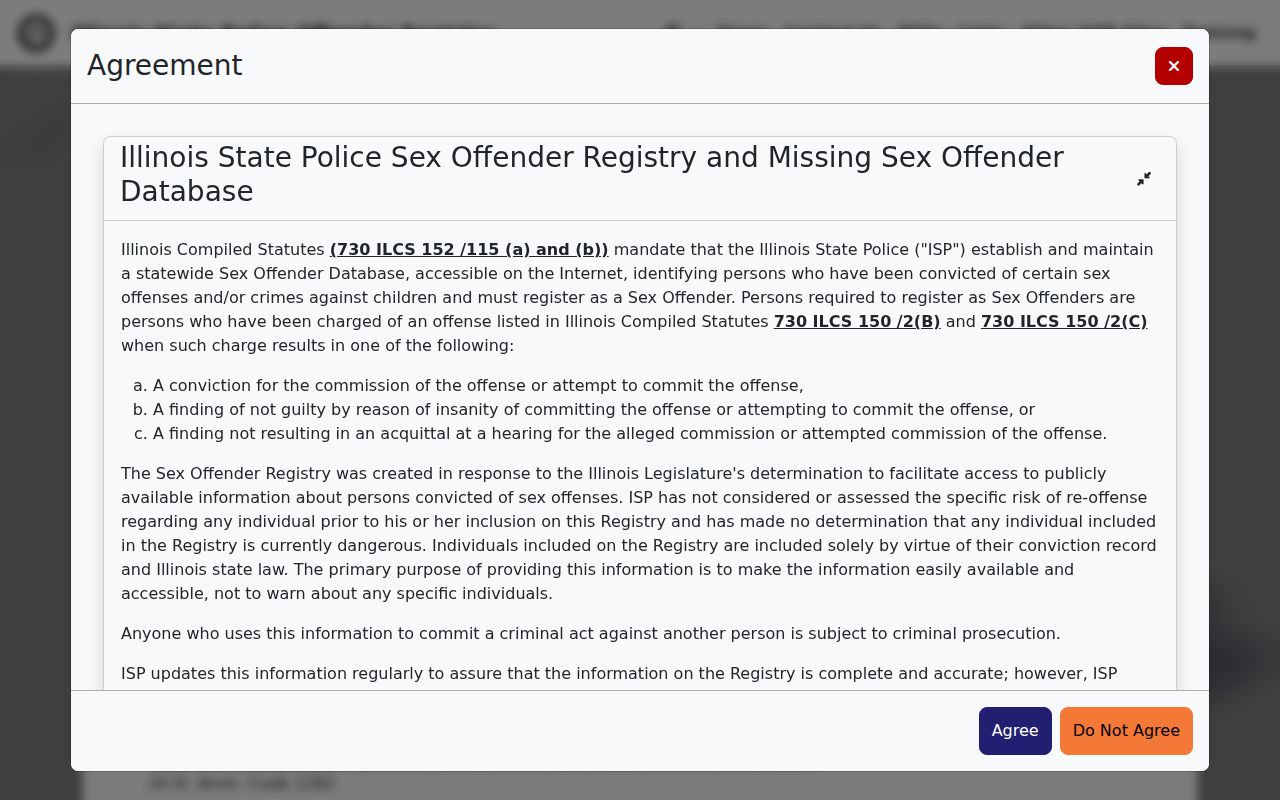
Open each relevant marker and verify the identity and current status rather than relying on marker placement alone.
Clark Registry Profiles: What They Show
A public ISP profile combines identity, location, offense, and registration fields. The full registration form used by an agency contains more data than the public page. Phone numbers, email or Internet identifiers, and supervision details collected for official work should not be assumed to appear publicly.
| Name and Aliases | Primary identity plus public alternate names. |
|---|---|
| Photo and Description | Current photograph, age or birth date, sex, race, height, weight, eyes, hair, and marks. |
| Registered Location | Residence or homelessness status and the registering agency. |
| Offense | Offense, statute, conviction or adjudication place and date, and age categories where public. |
| Type and Duration | Illinois statutory category and the stated registration period. |
| Status and Other Fields | Compliance status, public school or work data where authorized, and vehicle or plate information. |
Scars, marks, tattoos, aliases, and vehicle details can help distinguish people with similar names. Even so, the registering agency is the right source for a current status question.
Read offense and status as separate facts. The offense explains the legal basis tied to registration. Compliance status concerns current registry duties. Neither field supports a claim about conduct that the profile does not report. A court docket can add the filed case and outcome.
Where Clark County Residents Register
The correct office turns on jurisdiction. A registrant living inside a municipality reports to that city's police department. A person in an unincorporated part of Clark County reports to the Clark County Sheriff at 207 N. 5th Street in Marshall. Current hours and appointment rules should be confirmed with the responsible agency before a visit.
That division also tells a requester where to seek a related record. Registration forms remain with the registering agency. Conviction documents come from the Clark County Circuit Clerk. An incident report belongs to the police agency that investigated it. One Clark County sex offender search cannot merge those separate files.
Clark County Sheriff
207 N. 5th Street
Marshall, IL 62441
217-826-6393
Registration contact for unincorporated Clark County addresses; call for current scheduling.
Registration Levels and Duties in Illinois
Illinois does not publish registry duration under federal Tier I, II, and III labels. Its own statutory categories control. Some categories generally require ten years, while sexual predators and several other classifications register for natural life. Juvenile treatment depends on the offense and court, and ISP states that its juvenile code is hidden from the public website.
| Illinois Category | General Duration | Public Treatment |
|---|---|---|
| Sex offender, child victim | Generally 10 years unless a lifetime rule applies | Public |
| Sex offender, adult victim | Generally 10 years unless a lifetime rule applies | Public |
| Sexual predator | Natural life | Public |
| Sexually violent or dangerous person | Natural life | Public |
| Murderer, sexually motivated | Natural life | Public |
| Juvenile sex offender | Depends on offense and court | Hidden under stated ISP coding |
Verification schedules also differ. Some people verify every 90 days. Sexual predators generally verify each year for life, while a person without a fixed residence reports weekly. Published statutory fees are $100 at initial registration and $100 annually. A compliance failure can add ten years, and reincarceration may pause the time left.
Cross-State Clark County Searches
A Clark County registry search may miss an address or registration held by another state. The Dru Sjodin National Sex Offender Public Website provides the official cross-state layer. It draws from participating public registries, so a result still needs review at the state source that supplied it.
The national search interface is shown by the official NSOPW portal.
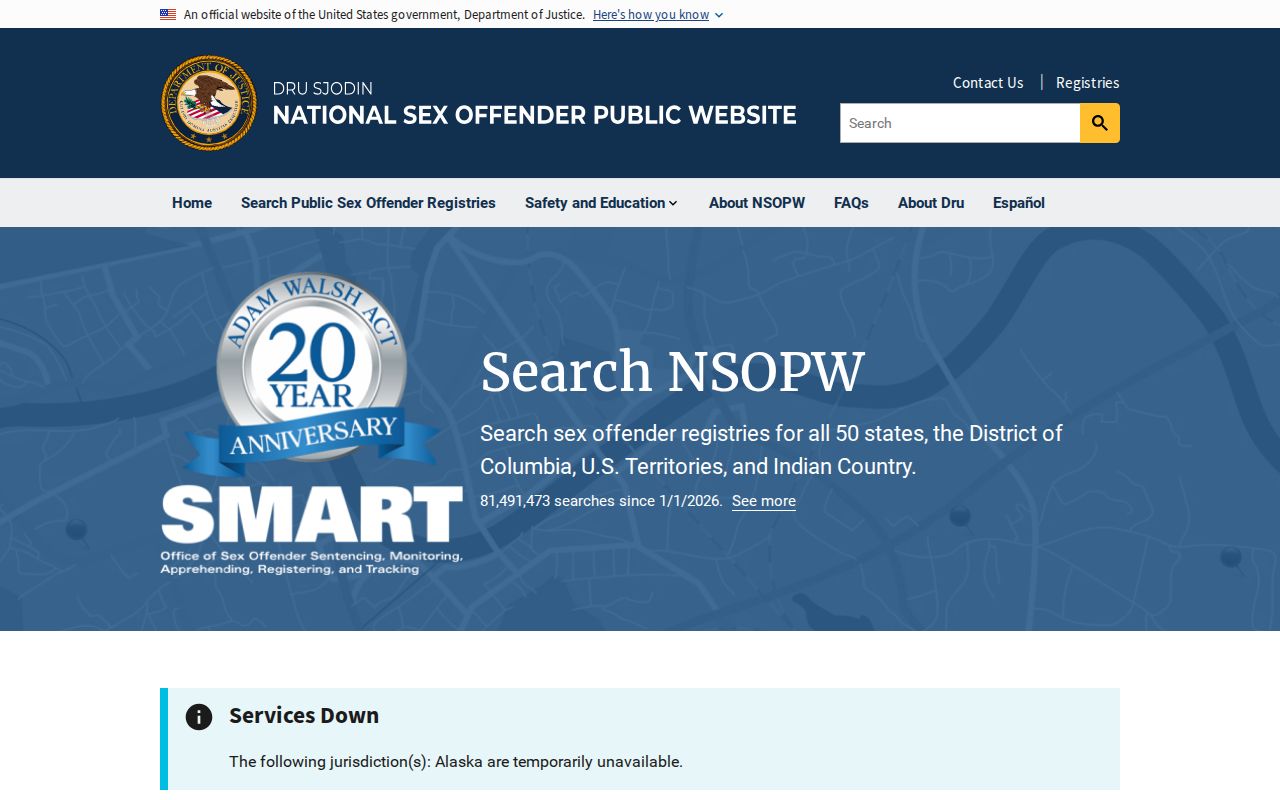
Use NSOPW when a person may have moved, then return to the linked state profile for the most specific public details.
Clark Registry Law Change Ahead
Public Act 104-131 has a September 1, 2026 effective date. The Clark County research was completed on July 19, 2026, before that date, so the duties and descriptions here reflect the law then in force. Readers checking after the effective date should confirm current ISP instructions and statutory text.
This timing matters because registry rules can change even when an older page or form remains online. ISP and the registering Clark County police agency are the best sources for a current duty. A court order or conviction file can explain the underlying case, but it does not replace current registration instructions.
Registration time may not match a simple calendar count. A compliance violation can add ten years from the first registration after that violation. Reincarceration can pause the time left. The public profile and registering agency provide a safer basis than calculating an end date from conviction year alone.
Using Registry Information Lawfully
Registry information supports personal, family, and community awareness. ISP warns users not to threaten, intimidate, or harass a registrant. Suspected noncompliance should be reported to local law enforcement or ISP. Do not confront the person or try to enforce registration rules yourself.
The ISP registry disclaimer states the conditions that a user accepts before searching.
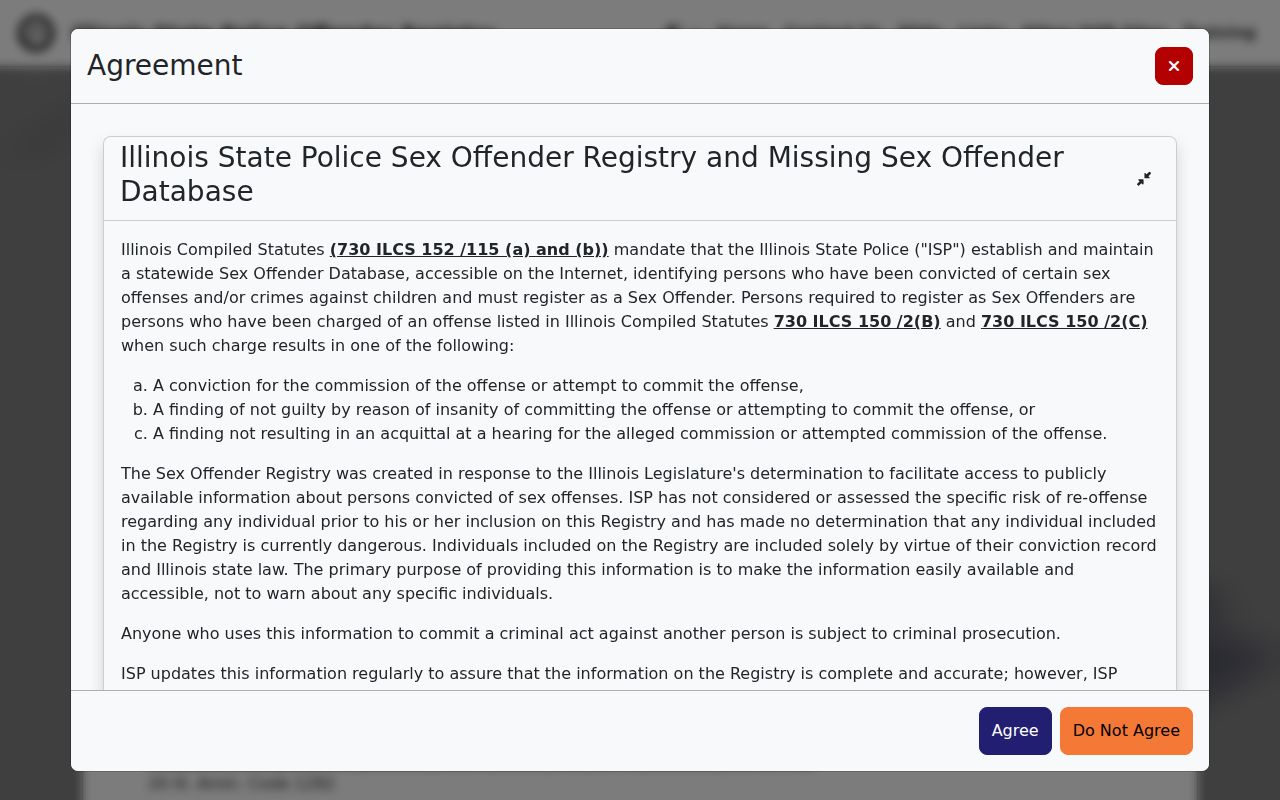
The warning is part of the official search path and applies to every Clark County registry result.
Misuse warning: Illinois law and the ISP registry disclaimer prohibit using registry information to threaten, intimidate, or harass. Misuse may be a crime. Report a concern to law enforcement instead of confronting a registrant.